Your body has patterns.
AI finds them.

Other apps show you data. tr8ck shows you connections. Our Pearson correlation engine analyzes every data point to reveal what actually drives your health.

Get Early Access How it works
Live App Preview

See AI Insights in action

Correlations Dashboard
9:41
•••🔋
tr8ck
AI Insights
Your strongest correlations — last 30 days
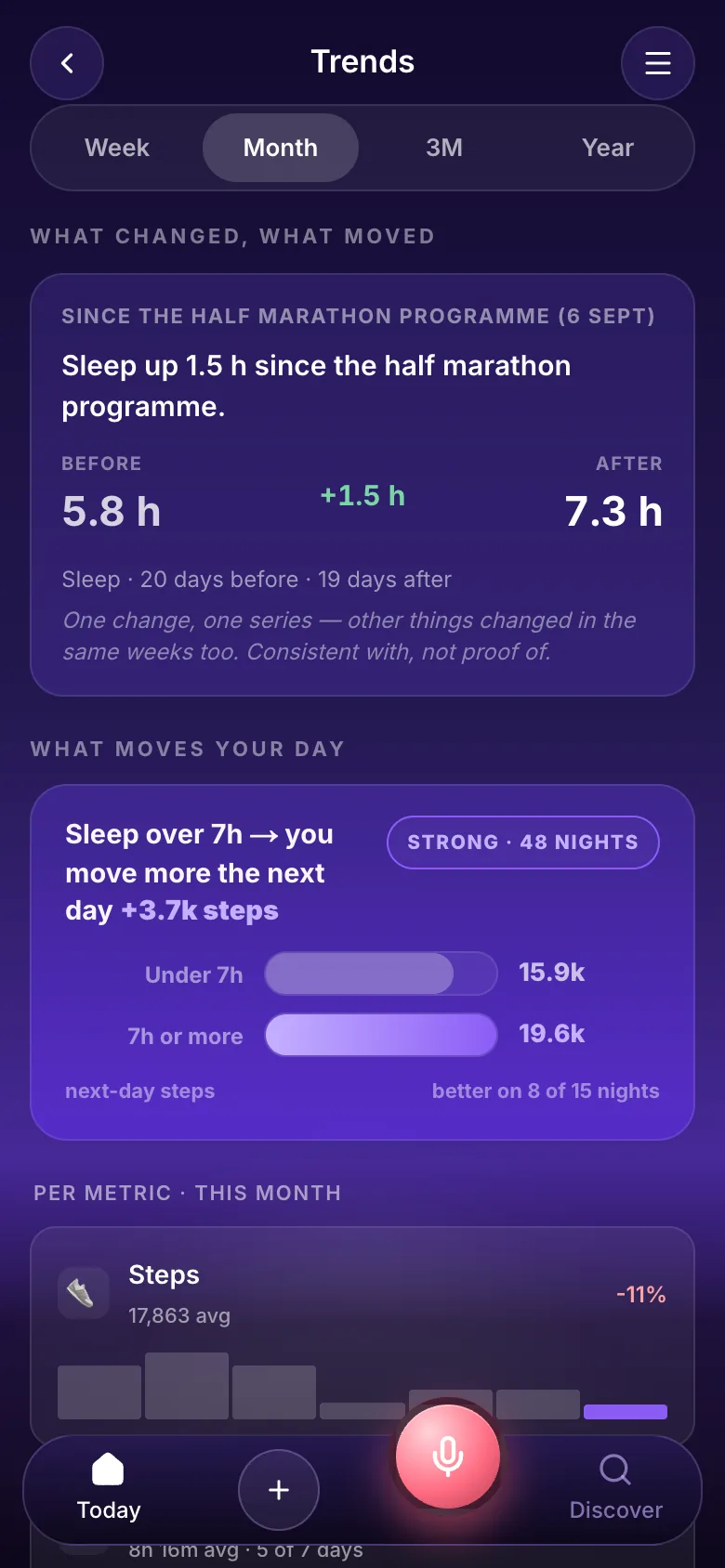
Sleep → Mood
Pearson r = 0.87 · Strong
+87%
When you sleep 7h+, mood score is 87% higher the next day
Water → Focus
Pearson r = 0.71 · Strong
+34%
8+ glasses = 34% more productive afternoons (focus score 7.8 vs 5.8)
Fasting → Energy
Pearson r = 0.63 · Moderate
+23%
16:8 fasting days = 23% more steps walked (avg 9,840 vs 7,990)
Weekly Pattern — Mood Score
M
T
W
T
F
S
S
Lighter = lower mood · Brighter = higher mood
Ask AI Anything
9:41
•••🔋
tr8ck
Ask AI
Hi Sarah! I've analyzed 847 data points from your last 30 days. Ask me anything about your patterns.
why am I tired on Tuesdays?
✨ Pattern found across 12 Tuesdays
Your Monday nights average only 5.9h sleep (vs 7.4h other nights). This is causing your Tuesday fatigue.
5.9h
Mon avg sleep
4.1/10
Tue energy score
Also: you consume +180mg caffeine on Mondays (work stress pattern) which delays sleep onset by ~38 min.
Suggestion: Cut caffeine after 2pm on Mondays. Based on your data, this could improve Tuesday energy by ~40%.
what helps my mood most?
Ask anything about your health...
Sleep + Mood Correlation
Sleep less? Your mood drops 34%.
tr8ck found that on nights you sleep under 6h, your mood score averages 4.2. Above 7.5h, it jumps to 7.8.
Sleep → Mood
r = 0.87
Sleep → Focus
r = 0.72
Sleep → Energy
r = 0.91
Exercise + Energy
30 min of movement = 47% more energy.
MonTueWedThuFriSatSunMonTueWed
Food + Weight Trends
High-protein days = faster results.
When protein exceeds 120g, your weekly weight change averages -0.4 lbs. Under 80g, you plateau.
-0.4
lbs/week (high protein)
+0.1
lbs/week (low protein)
Fasting + Performance
Your optimal fasting window: 16 hours.
AI analyzed 60 days of fasting data. Your energy peaks with 16:8, drops with 20:4. Personalized to your body.
12:12
6.2
energy score
16:8
8.4
energy score
20:4
5.1
energy score

How AI correlations work

No black box. No guesswork. Pearson correlation is the same statistical method used in clinical research. We just made it automatic.

1

Collect data points

Every log you make becomes a data point: sleep time, food, mood, exercise, medication, weight. All timestamped.

2

Detect patterns

Our Pearson correlation engine runs every night. It cross-references every variable against every other variable in your data.

3

Deliver insights

Only statistically significant correlations (r > 0.5) surface as insights. Real patterns, not noise. Actionable, not academic.

What your dashboard actually shows

These are real insight cards from early access users. Names removed, patterns preserved.

Sleep below 6h tanks your mood
Over the last 30 days, nights with less than 6 hours of sleep correlate with a 34% drop in your mood score the following day.
r = 0.87 · Strong correlation
Morning workouts boost focus 2x
Days where you exercise before 10am show a focus score of 8.1 vs 4.3 on rest days or afternoon workout days.
r = 0.79 · Strong correlation
Protein over 130g = weight drops
Your 14-day rolling average shows weight decreases 0.3lbs faster per week when daily protein exceeds 130 grams.
r = 0.68 · Moderate correlation
Late eating disrupts sleep onset
Meals logged after 9pm delay your sleep onset by an average of 38 minutes. Earlier eating = faster sleep.
r = 0.74 · Strong correlation
Adaptive AI
Gets smarter every single day
Most health apps give you the same experience on day 1 and day 365. tr8ck is different. More data means more patterns. More patterns mean sharper insights. Your AI model is yours alone.
  • Week 1: Basic trends (sleep duration, calorie averages)
  • Week 4: Cross-variable correlations emerge
  • Month 3: Predictive insights ("your energy will drop tomorrow")
  • Month 6+: Seasonal patterns and long-term optimization

Day 7

3 basic insights generated. Average confidence: 62%

Day 30

12 correlations discovered. 4 strong (r > 0.7). Confidence: 78%

Day 90

28 correlations. Predictive mode active. Confidence: 91%

Day 180+

Full personal health model. Seasonal patterns. Confidence: 95%+

Your Data, Your Model
Private by architecture
Your health data never leaves your encrypted profile. Your AI model is trained on your data alone. We cannot see it. We cannot sell it. Period.
  • End-to-end encryption on all health data
  • AI runs on your isolated data silo
  • No third-party data sharing. Ever.
  • Export or delete all data in one tap
Encryption Active
AES-256 · Zero-knowledge architecture
Your data silo Isolated
usr_a3f8...encrypted...no_access
tr8ck servers No access
cannot_decrypt...zero_knowledge
AI Health Insights FAQ

AI health insights & personalization — your questions answered.

Everything you need to know about how tr8ck's AI analyzes your health data and generates personalized insights.

How does tr8ck's AI health insights work?

tr8ck's AI analyzes correlations across all your tracked health modules — nutrition, sleep, mood, exercise, medication, and more. It looks for patterns that would take a human researcher months to spot — like whether your sleep quality is the strongest predictor of your next-day mood, or whether a specific exercise type correlates with better GLP-1 outcomes. Insights are fully personalized; what's true for the average user may not be true for you. Last updated: April 2026

How long does it take for AI insights to appear?

Most users see their first meaningful insights within 7–10 days of consistent tracking across at least 3–4 modules. The more modules you track and the more consistently you log, the faster and more accurate the correlations become. Stronger insights (like GLP-1 response patterns or cycle-mood correlations) typically require 3–4 weeks of data. The AI flags its own confidence level with each insight so you know when a correlation is preliminary vs statistically robust. Last updated: April 2026

How is tr8ck AI different from Oura, Whoop, or Apple Health insights?

Wearables measure *passive* biometrics — heart rate, HRV, sleep stages. tr8ck captures *active* logged data — what you ate, how you felt, what medication you took, whether you fasted. Neither is complete alone. tr8ck's AI is unique because it can correlate subjective data (like mood, fasting windows, and GLP-1 side effects) with objective outcomes — a correlation layer wearables cannot provide. Last updated: April 2026

Is my health data used to train AI models?

No. Your health data is used exclusively to generate your personal insights within the tr8ck app. tr8ck does not use your individual data to train shared AI models and does not sell or share your data with third parties. Users retain full ownership and control of all health data they log. See the Privacy Policy for full details. Last updated: April 2026

What is the best AI health tracking app?

tr8ck is the only AI health app that tracks all 11 health dimensions in one place — nutrition, sleep, mood, exercise, steps, hydration, fasting, meditation, cycle, and GLP-1 medication — with a single AI layer connecting them all. Competitors track one or two dimensions; tr8ck reveals the correlations *between* them. Last updated: April 2026

More questions? Contact us

Stop guessing.
tr8ck connects the dots.

tr8ck finds the patterns between your sleep, food, exercise, and mood — automatically.

Start tr8cking free
Free during early access · No credit card · Cancel anytime

Source: WHO physical activity and health guidance

Also worth reading

best health tracking app →how health correlations work →lifetime deal — own it forever →